It's been a weird summer so far in Illinois, with lots of heavy rain, some very hot days, some very cool spells, and then more rain. So I take garden pics when I can ... in between rain drops. I even have to keep the plastic chairs tipped so the seats don't fill with rain!
But of course roses love rain. That's why they love England, I guess. The pic above is a cute little shrub rose with diminutive blooms of light pink called The Fairy. Many of our other roses have died back to below the graft, and so the common red rootstock is all that's left. But they are pretty in their own way too.
Roses are not easy to grow in Illinois in my opinion, especially the delicate tea roses that don't like water on their leaves (but plenty in the soil), winters that are too cold, summers that are too hot, bugs that eat them, etc.
I have had better luck with shrub roses and mini-roses, like the one shown above, in the raised beds than I have with tea roses. I tried the exotic and beautifully full hybrids between modern tea roses and old roses that David Austin creates, but they don't like Illinois much either. This year we just planted a Knockout double red shrub rose. I see it all over town this year, so maybe it's going to work for us!
Hydrangeas are coming into their own about now all over town too. The so-called mopheads in brilliant colors don't really like Illinois winters, except for a few hybrids (like "Endless Summer") that bloom on new wood, so don't lose the next year's blooms during an extra cold winter. But the oakleaf hydrangeas do great here (and so do the later blooming paniculatas).
Here's a close-up of our oakleaf hydrangea, blooming in the northeast part of the garden in a fair amount of shade. The blooms last into the fall, slowing turning the color of old lace.
Quite a few years ago, I bought a small plant in a pot at a private sale that was labeled "native hydrangea." It has turned into a huge bush, blooming very reliably every year, forming a nice background for the ostrich ferns.
This past year we added two of the "snowball" type of hydrangeas, and they are blooming now. Here's a pretty white one.
And a pink one with one large lovely bloom so far.
Related to the climbing hydrangeas is a fantastic vine called Schizophragma. They take a long time to establish and flower (six years or more), but they are so beautiful and are one of the few flowering vines for shade.
Here's a close-up of the interesting flowers with their two very distinct parts.
I have another one climbing up the pin oak, but it's too young for blooms yet. My friend Frank has a pink one. I want a start from it sometime!
I can't talk about shade plants without giving praise to hostas ... one and all. There are so many lovely ones ranging from dwarf hostas in barrells to giant like this sieboldii planted in a circle beneath the northmost Chinese dogwood. Its pure white flowers (most hosta flowers are lavender) are just delightful.
When we moved this hosta to the present garden from our prior garden, it was really big, so we decided to break it up into six pieces and plant in a circle. Now each one is as big as the original was!
Here's the tree the hostas encircle. It's a Chinese dogwood (Cornus kousa). The Cornus florida, in white, pink, or rose, is the more common early spring-blooming dogwood in these parts, but this one has huge flowers and blooms late enough that it is never ruined by spring frosts.
As you can see, the four-petaled flowers are very striking. They last a pretty long time as well.
Let's go from cool white in the shade to hot orange in the sun with these very bright Asiatic lilies. They come from bulbs, large ones that are planted very deep in the soil in the fall. I've had these a while and they are always a welcome bit of color in June.
Speaking of bright color, these Lychnis coronaria, sometimes called Rose Campion, are like neon signs. The foliage is a soft hairy downy light green, almost white in places, but the blooms are pure magenta. It seeds around a bit, but it isn't too hard to pull up (if you can force yourself to do it ... I'm such a soft-hearted gardener that we have "volunteers" everywhere).
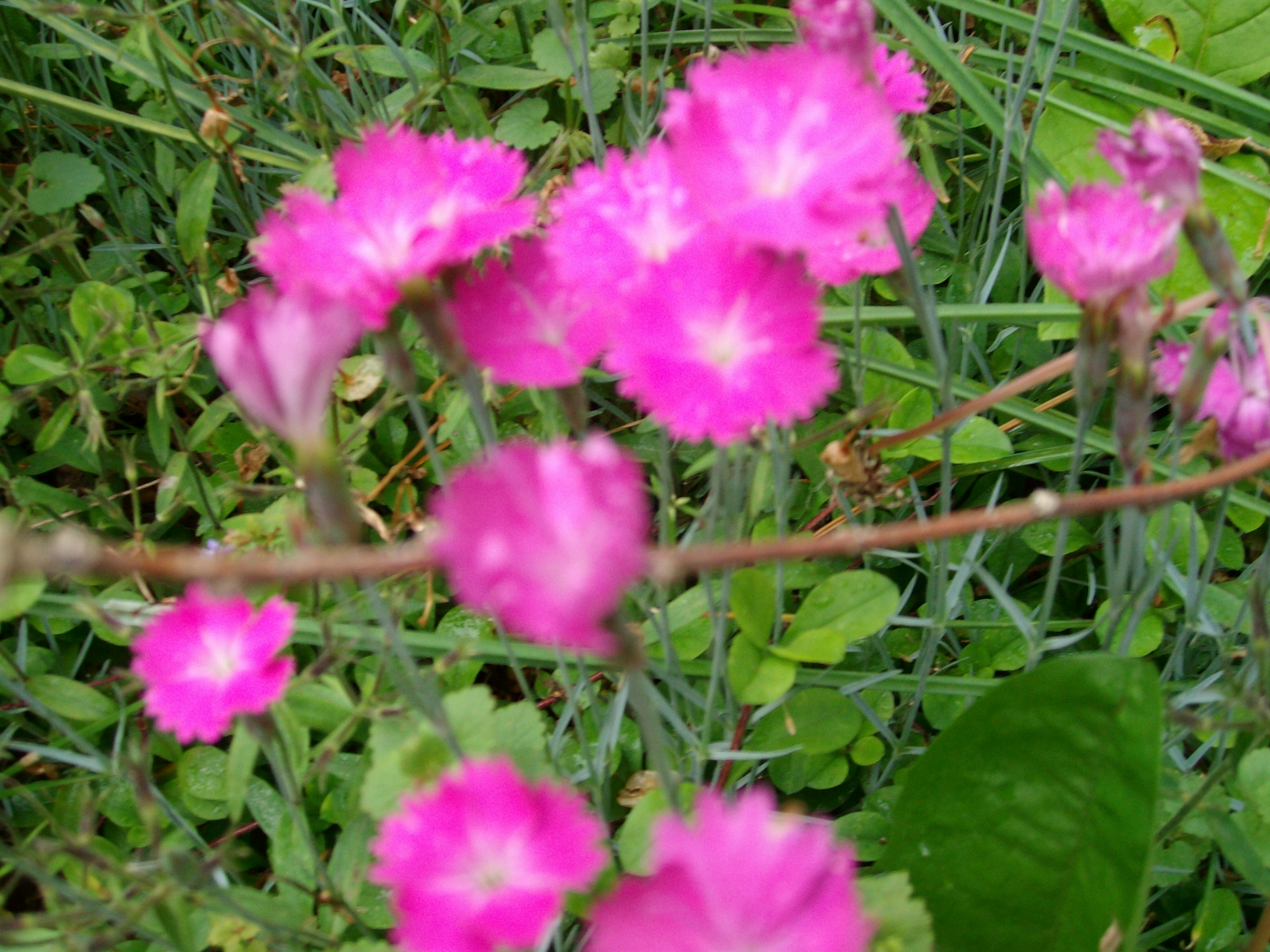
Dianthus can be brightly colored too. Here's one we just got this year; it's blooming already with that cute dark eye. These are in the "pinks" family along with florist's carnations and tiny alpine dianthus with itty bitty flowers.
Here's another beautiful dianthus with remarkable patterning. Dianthus aren't always reliably perennial because they dislike the wet winters we have in Illinois, so I'm not sure which named hybrids are still around or not ... but I think this is one called Laced Romeo.
Now that the evening primrose has finished, there aren't too many bright yellow things in bloom in the garden. This is a tall sedum with starry flowers (a bit out of focus, sorry) that I grew from seed and transplanted from an earlier garden. The seed was from the garden of a French gardener who was here visiting and came to my garden because we both belonged to the French seed exchange society at the time. So it's a special sedum for me.
For a delicate range of colors both bright and subdued, this small shrub is perfect. It's an Anthony Waterer Spirea. The flowers themselves resemble those of the Achillea, but they are not related as far as I know.
The close-up shows even better the range from light rose to a soft fuschia color. It's an easy shrub too, pretty undemanding in good light and reasonable soil.
There are lots of different spireas, including the well-known white bridal veil spireas you see blooming earlier in the spring.
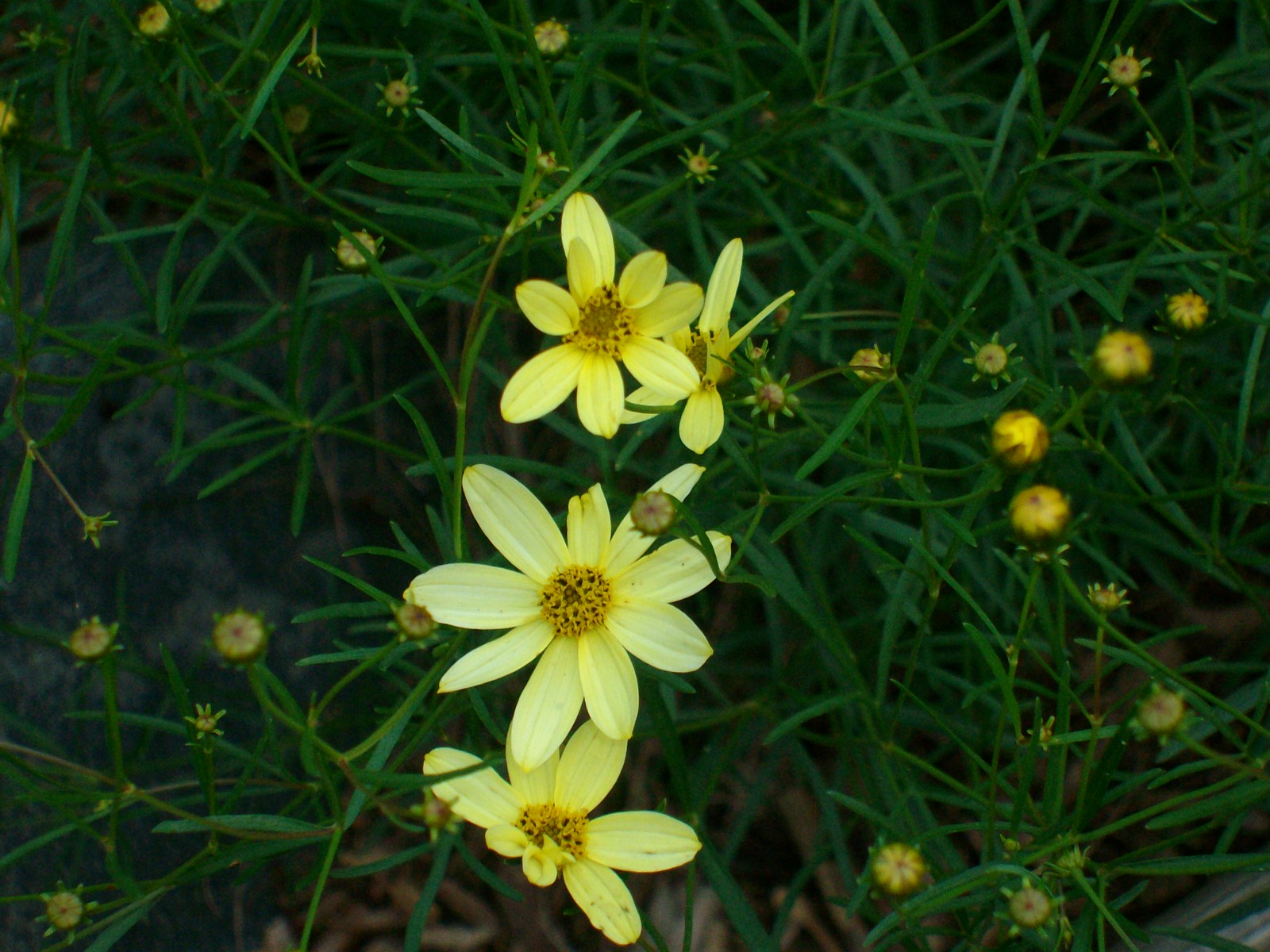
Soft pale colors are wonderful in the garden too, and the "moonbeam" Coreopsis is a lovely lemony yellow. The foliage on these "threadleaf" types is pretty even when they aren't in bloom.
I'm not sure why Clematis don't seem to be so easy for me to grow. I think they are hard to establish. It's said that they like their feet in the shade and their heads in the sun ... and that isn't a common situation in my yard. I have planted them many times in several different gardens. I seem to have the best luck with the purple ones, especially the jackmanii variety of vine.
This pretty little wine-colored one near the gate is proving me wrong, however. It is establishing quite well and although the flowers are small, it's a charmer. I think is a Polish hybrid of a species clematis.
Of course, some plants are a bit too easy. This penstemon with its white flowers and red stems is a cutie, but it does tend to sow around in places in the path as well as in the beds. It's tall and cheerful though. I guess I never met a flower I didn't like?
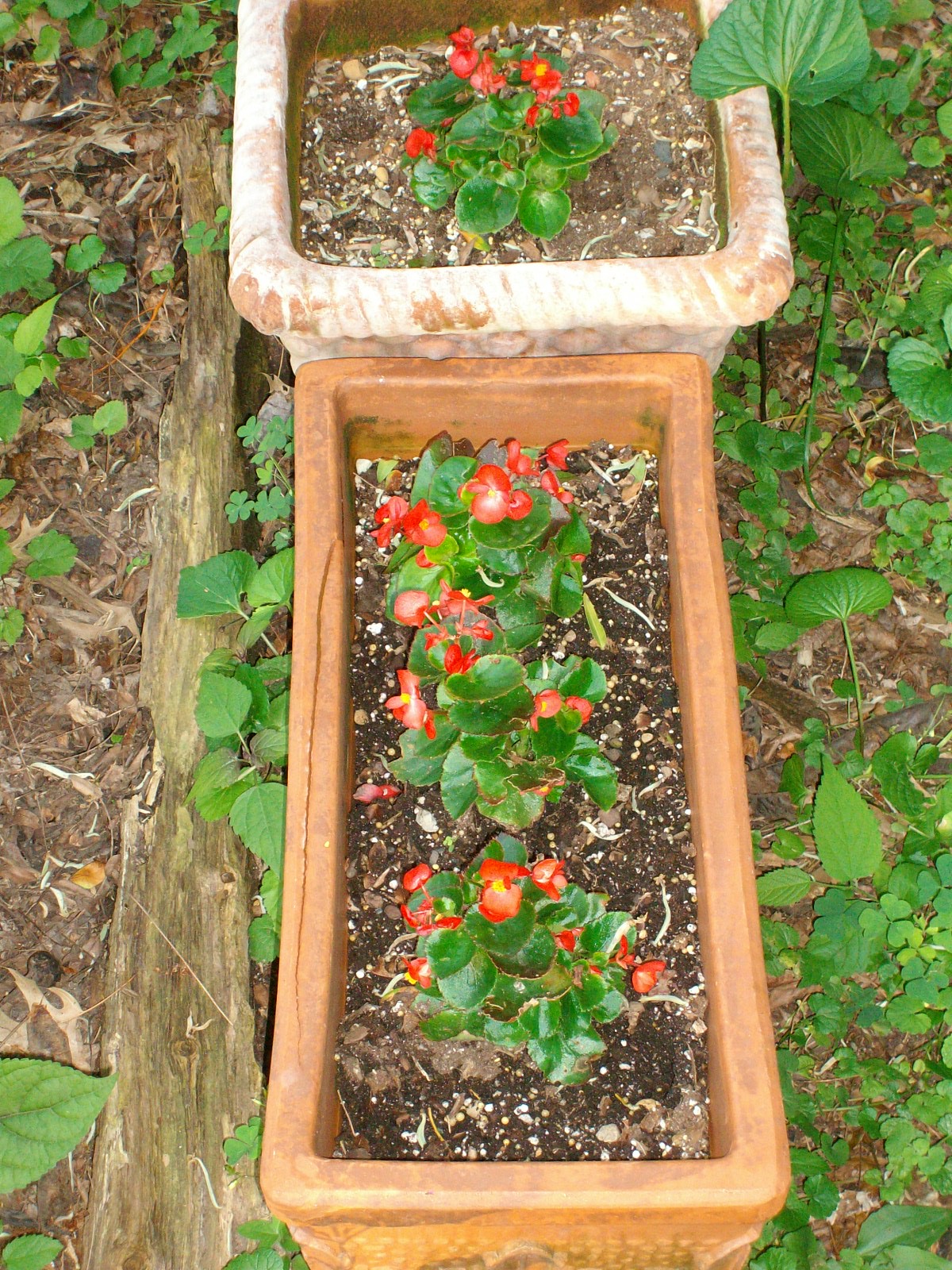
Even the recently planted annuals in pots and containers are starting to show some growth. Here are terra cotta planters with red wax begonias in them.
And a concrete planter, also in the shade, with bicolored impatiens.
Double impatiens is a favorite annual of mine in shade. Here it is in a hanging basket in front of the kitchen window.
Although this pot isn't very showy yet, it will be later as it fills out. The purple wave torenias with orange impatiens were a striking combination last summer.
This pot in the sunny east side contains an interesting dark petunia I hadn't seen before, along with a red aster, a salmon geranium, a white angelonia, and an orange dahlia. Lots of colors!
Here's a close-up of that petunia. The color here is pretty true ... it's really that dark!
Here's a lively combination of pink and red verbena with a dark foliage plant and a yellow lantana.
The Calibrachoa "superbells" are charming little guys. Here we have one called Blackberry Punch and another magenta one mixed in with white vinca to show them off. I think I've got a dark red ivy geranium in there too that hasn't quite taken off yet.
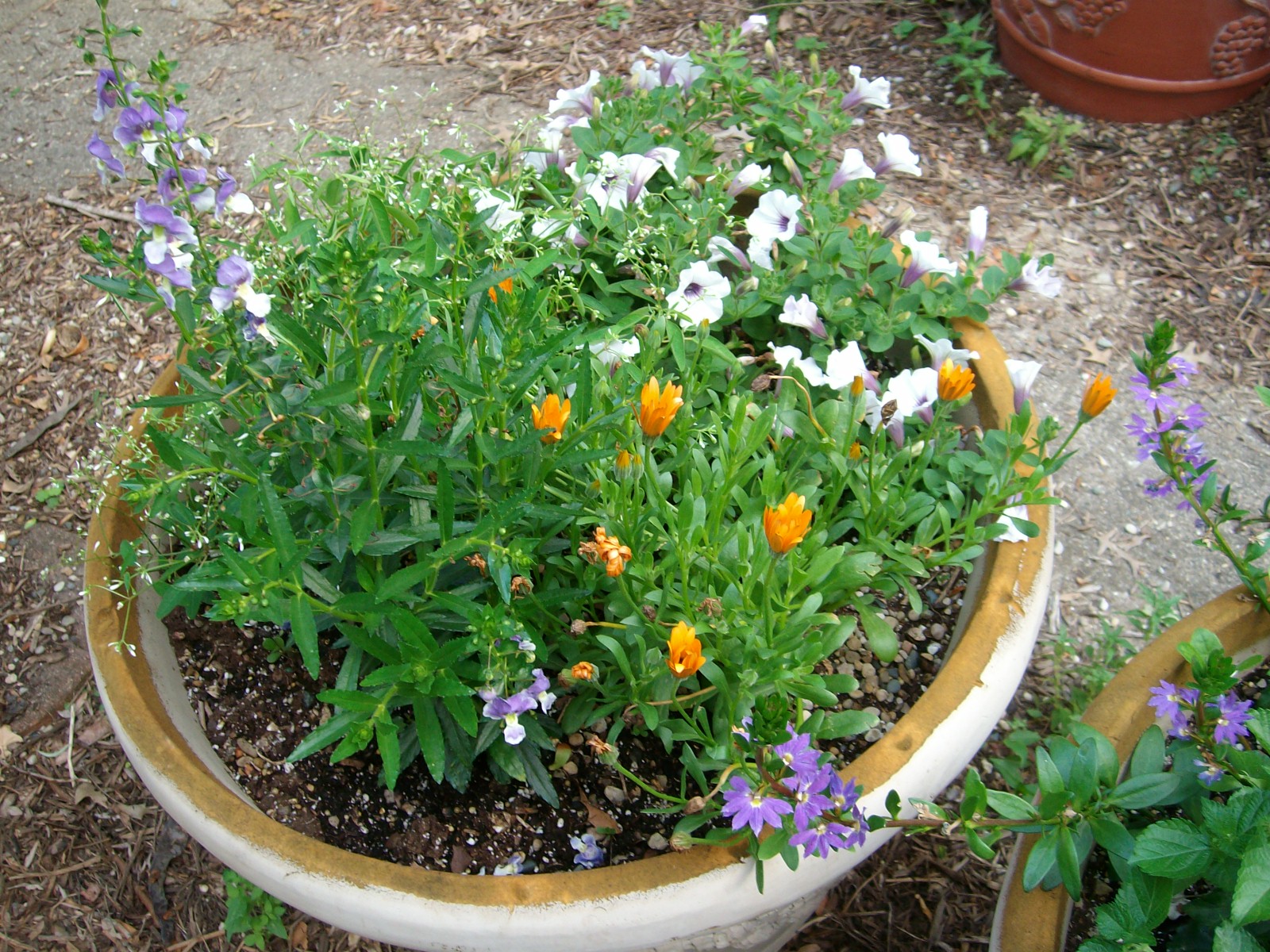
Angelonia, blue scaveolens, orange osteospermum (from South Africa) and white/plum petunias fill this pot and will, hopefully, look even better in the next set of pics.
The yellow here is an annual called Bidens; it's a new one for me, but supposedly it is drought and heat resistant. There's lantana in a pale yellow and pink combination too and purple angelonia.
The bright red pentas (my mom used to have these in her Florida garden) and red superbells look good with that variegated fuzzy foliage plant (helichrysum of some kind?).
This shot shows the bicolor aspect of the lantana better.
For the small pots near the front door where it's less sunny, I'm hoping this blue lobelia can last through the hot days. I know the red vinca will endure and stay brilliant all summer.
Well, that's all for now folks. Hope you enjoyed it!
Friday, June 17, 2011
Friday, June 10, 2011
Chihuly
People on Etsy love to make colorful displays, called "treasuries," of beautiful items they find in Etsy shops. Today there is a treasury on display by a woman who just attended an exhibit of the artist Chihuly's amazing glass work. I saw a DVD a while back of his exhibit at the Garfield Park Conservatory in Chicago. The huge complex blown glass pieces were truly astonishing.
The treasure includes a pair of blown glass earrings from my shop, Beaded Jewelry by Susan. Have a look!
Wednesday, June 1, 2011
Lots in Bloom
Lots of blooms in the garden now. I took these photos just before the big downpours finished off the rhododendrons. Here's a close-up of the same plant.
It's a roseum elegans that I planted about twelve years ago. It's shady here in the north yard and we have a light mulch of chopped leaves at the base of the rhododendrons.
The red one is nova zembla and it's a smaller bush but very bright.
We added this pink one just a few years ago, but it's already blooming pretty well.
The beauty bush (Kolwitzia amabilis) was already here when we bought the place sixteen years ago and it just keeps getting nicer every year. It's a very tall bush, located in more shade than it would prefer, but it blooms every year. The small white blossoms have orange freckles inside ... very charming.
We have two of these red honeysuckle (Lonicera) vines, both of which were labeled "Dropmore Scarlet." But this one is earlier blooming and redder than the more orange one. This one has finished already, but yesterday I saw a hummingbird on the later one. The tiny birds love the long-necked blossoms for their nectar!
Some plants show off flowers, but for others foliage is the name of the game. With all the rain we've had, the ostrich ferns are looking good this year, as are the hostas. The white flowers in the photo above are meadow rue (Thalictrum).
The siberian iris are lovely this year and we have lots of them. They are easier to grow than many other irises and they have delicate, tall leaves that are attractive even after the blooms are finished.
The siberian iris are especially pretty next to the early blooming white peonies. I need to take some more pics, because now all the lactiflora peonies (i.e., "regular" peonies as opposed to the earlier woody tree peonies) are in bloom.
But it was the white ones (very fragrant) that started this show.
This bright red peony is a hybrid I bought many years ago from a daylily, iris, and peony breeder who lived in Monticello, Illinois. It is named Eliza Lundy.I can't cook without onions, and I can't imagine a garden without some of these giant onions (Allium giganteum). I bought three bulbs many years and two gardens ago, and they have moved well, spread well, and bloomed well with no coddling whatsoever ... very reliable plants.
I love all the "pinks"--Dianthus, the family that florist carnations hail from. They come in a wide range of sizes and coloration, and some are very sweetly scented.
I also love the columbines (Aquilegia). The native ones are yellow and red, but the hybrids come in all colors and sizes. I was once told by a plant friend that columbines were very "promiscuous" and so they cross and cross and nobody knows which hybrid is which in their garden.
These tiny but charming flowers are from a dwarf shrub called Deutzia nikko. The whole thing is only about six inches tall and puts up with a fair amount of shade and neglect but blooms every year in late spring. I just love it.
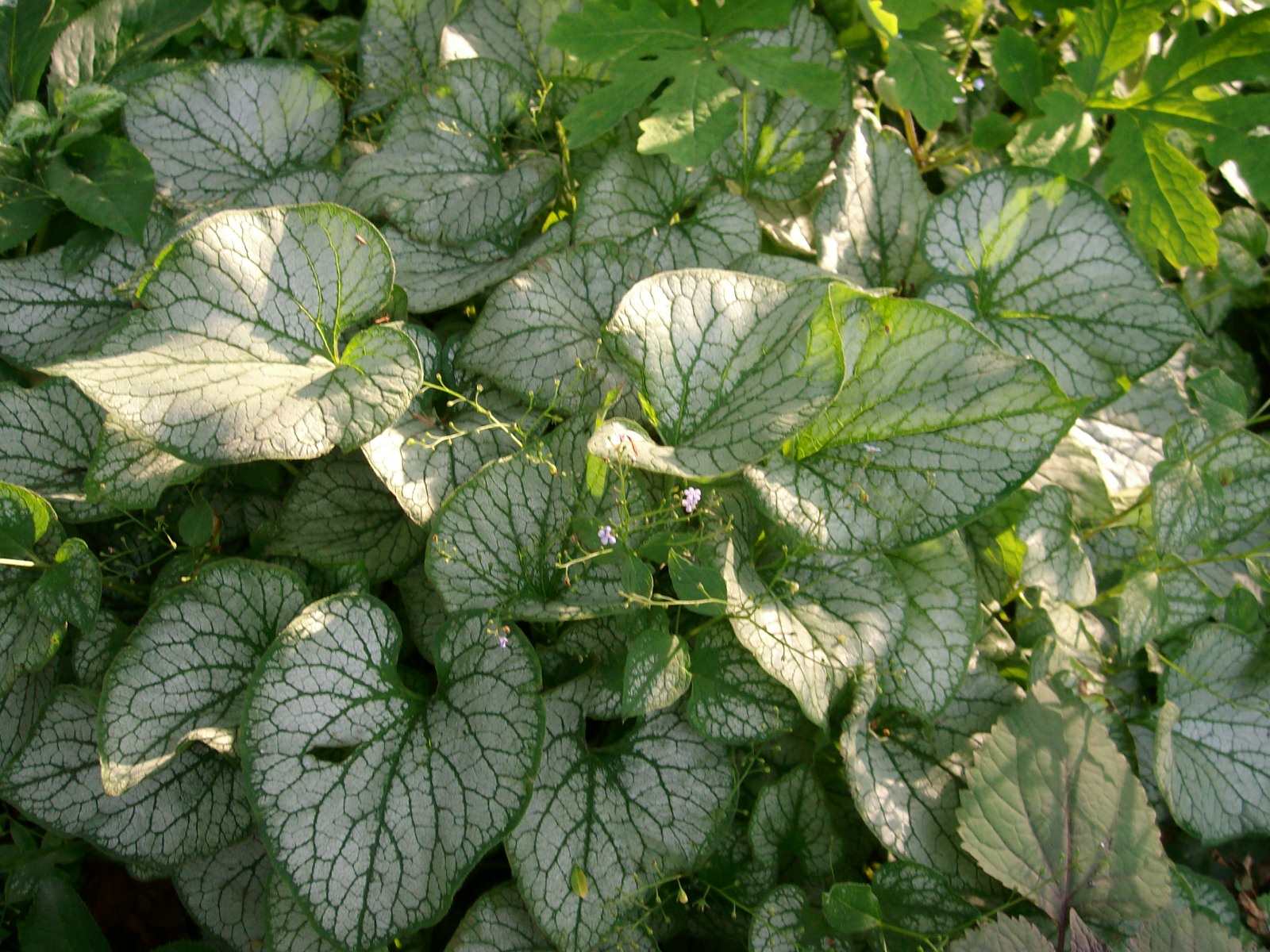
Even though the forget-me-not blue flowers have finished on all of the Brunnera macrophylla in my garden, the "Jack Frost" hybrid is still pretty showy because of its foliage.
The Japanese painted fern also has very striking foliage. There are a number of varieties of this fern on the market now and they are all nice to have.
There is just one northern maidenhair fern, to my knowledge, but with its black stems and oh-so-dainty fronds it's one of my favorite plants.
Well, already many of these beauties have finished their season of flowering and others have come into bloom to take their place (turn, turn, turn), so I will need to go out with the trusty digital sometime soon again. In the meanwhile, I have been busy planting annuals in all the containers and buying some perennials to fill in beds that are going to be weeded. Below is the first annual planter pic. I'll take pics again later as the annuals grow and fill in the pots more.
So ... happy summer! Happy gardening!
It's a roseum elegans that I planted about twelve years ago. It's shady here in the north yard and we have a light mulch of chopped leaves at the base of the rhododendrons.
The red one is nova zembla and it's a smaller bush but very bright.
We added this pink one just a few years ago, but it's already blooming pretty well.
The beauty bush (Kolwitzia amabilis) was already here when we bought the place sixteen years ago and it just keeps getting nicer every year. It's a very tall bush, located in more shade than it would prefer, but it blooms every year. The small white blossoms have orange freckles inside ... very charming.
We have two of these red honeysuckle (Lonicera) vines, both of which were labeled "Dropmore Scarlet." But this one is earlier blooming and redder than the more orange one. This one has finished already, but yesterday I saw a hummingbird on the later one. The tiny birds love the long-necked blossoms for their nectar!
Some plants show off flowers, but for others foliage is the name of the game. With all the rain we've had, the ostrich ferns are looking good this year, as are the hostas. The white flowers in the photo above are meadow rue (Thalictrum).
The siberian iris are lovely this year and we have lots of them. They are easier to grow than many other irises and they have delicate, tall leaves that are attractive even after the blooms are finished.
The siberian iris are especially pretty next to the early blooming white peonies. I need to take some more pics, because now all the lactiflora peonies (i.e., "regular" peonies as opposed to the earlier woody tree peonies) are in bloom.
But it was the white ones (very fragrant) that started this show.
This bright red peony is a hybrid I bought many years ago from a daylily, iris, and peony breeder who lived in Monticello, Illinois. It is named Eliza Lundy.I can't cook without onions, and I can't imagine a garden without some of these giant onions (Allium giganteum). I bought three bulbs many years and two gardens ago, and they have moved well, spread well, and bloomed well with no coddling whatsoever ... very reliable plants.
I love all the "pinks"--Dianthus, the family that florist carnations hail from. They come in a wide range of sizes and coloration, and some are very sweetly scented.
I also love the columbines (Aquilegia). The native ones are yellow and red, but the hybrids come in all colors and sizes. I was once told by a plant friend that columbines were very "promiscuous" and so they cross and cross and nobody knows which hybrid is which in their garden.
These tiny but charming flowers are from a dwarf shrub called Deutzia nikko. The whole thing is only about six inches tall and puts up with a fair amount of shade and neglect but blooms every year in late spring. I just love it.
Even though the forget-me-not blue flowers have finished on all of the Brunnera macrophylla in my garden, the "Jack Frost" hybrid is still pretty showy because of its foliage.
The Japanese painted fern also has very striking foliage. There are a number of varieties of this fern on the market now and they are all nice to have.
There is just one northern maidenhair fern, to my knowledge, but with its black stems and oh-so-dainty fronds it's one of my favorite plants.
Well, already many of these beauties have finished their season of flowering and others have come into bloom to take their place (turn, turn, turn), so I will need to go out with the trusty digital sometime soon again. In the meanwhile, I have been busy planting annuals in all the containers and buying some perennials to fill in beds that are going to be weeded. Below is the first annual planter pic. I'll take pics again later as the annuals grow and fill in the pots more.
So ... happy summer! Happy gardening!
Monday, May 23, 2011
Brazilian Blast
It's always a special occasion when Desafinado plays, but last Saturday night at the Iron Post was a Brazilian blast of fun and music. Everybody was in top form, the songs were great, the audience was enthusiastic, and there was lots of variety--with friends joining in at various times. In the photo above, you can see the incomparable Elis Artz belting out her heart in these gutsy, romantic, rhythm-filled Brazilian favorites--with George Turner on guitar at her side.
On several numbers, Gina Reynolds, whose lovely soprano voice was known to us as the singer from another local Brazilian band called Bate Calado, joined with Elis Artz in a vocal duet. Their voices complement each other very well, and it was a pleasure to hear their harmonies. They both sing in Brazilian Portuguese, of course, and also sort of dance while they sing, which helps get that samba rhythm going throughout the room.
Gina did a solo number as well, and you can see that George Turner on guitar and Tom Paynter on flute were on hand to back her up.
Tom is a talented multitasker: in addition to the flute (soprano and alto), he is a highly accomplished jazz pianist. The Baldwin at Iron Post had been tuned recently (we heard Tom's quartet play there Thursday night) and the sound was wonderful!
Another member of the Bate Calado band, Luciano Tosta, has joined Desafinado full-time. Luciano is from the northeast of Brazil, as is Elis. He plays an electric mandolin, a small guitar, and a very wide range of intriguing percussion instruments. These include cymbals, gourds, whistle, and wind chimes!
Luciano's charming young daughter, Anna, was on hand. She hit the cymbals on a cue from her dad and was delighted to help out!
Another musician known about town as playing with quite a few bands, including Bossa Nuevo, is Karim Yengsep. Karim has become a regular with Desafinado, playing either acoustic bass or electric bass. And we're glad he's joined! He's a passionate and talented addition indeed.
But to me Brazilian music (and Cuban as well) is never quite right without the infectious sound of the congas. Giraldo Gonzales is one of the original members of Desafinado and he used to also play with Sandunga in the past, the Cuban guajira son band that we like so well. Giraldo is a busy guy with job, family, and community politics going on, but he makes time to come and provide the beat that keeps me tapping the table (spilled some of Elis' wine at one point during a very lively number).
Here's a nice solo shot of guitar virtuoso George Turner. I've heard George playing with a number of local groups about town and now he has joined Desafinado. He did some terrific solos during this gig. Every time I hear him he's just getting better and better with that sweet guitar improv.
Of course, I can never say enough about the fantastic voice of Elis Artz. I was so amazed to learn a while back that she was not a professional singer back home in Brazil but had started singing with the Desafinado band here in C-U. Her singing is magical and she is such a radiant person, so obviously delighted with the tunes themselves that you can't help learning a few lyrics in Portuguese and singing along from time to time.
Elis, who is going to Brazil soon for a six-week visit to family back home, knows lots of Brazilians here in town. Saturday night two of her friends were available to do a couple of numbers with her. Unfortunately, I didn't get their names, but they were both talented and the songs were great.
This guy played a special kind of drum as well as singing a duet with Elis while the other friend played guitar. After their numbers, I told my husband David, "When you see Brazilians making music together, you can tell that these are a people who know how to have fun!" The two friends agreed heartily when I repeated it to them.
In addition to some favorites, including some songs by the great Antonio Carlos Jobim, the group played several pieces I hadn't heard before. All the choices were terrific, ranging from soulful sambas to lively toe-tappers.
I forgot to include the tambourine as one of Luciano's specialties.
Tom sometimes plays a chord on the piano at the same time as he's playing the flute. In the photo above, I caught him including the melodica as well, a really cool portable keyboard instrument he blows into, making a sound a little bit like an accordion. It's a unique sound and a just-right addition to many of the songs the group performs.
Giraldo was off in a dark corner, but I managed to get one more pic of him. He's always smiling and nodding along with the music. He doesn't sing, but I suspect that he knows all the words ...
Karim seems to have that ability to enter completely into his bass playing so that he appears to be in a musical trance! Delightful!
Elis and Gina did another duet near the end of the evening, joining together for that most famous (in the U.S.) of Brazilian songs, popularized by Burt Bacharach, "The Girl from Ipanema."
Desafinado is a terrific group, and I'm always surprised that they don't do more gigs than they do. I think people are beginning to get to know Brazilian music locally and it's getting more popular.
I noticed too that a lot of local musicians support each other by showing up for gigs. It's nice to see familiar faces and socialize a bit during the breaks. I think that if the owner of the Iron Post would make an effort--maybe clean the place up a bit, get more comfortable chairs, and expand the food menu as well as bringing back great musicians like those in Desafinado--that the Iron Post could become a really premiere jazz club in Champaign-Urbana.
On several numbers, Gina Reynolds, whose lovely soprano voice was known to us as the singer from another local Brazilian band called Bate Calado, joined with Elis Artz in a vocal duet. Their voices complement each other very well, and it was a pleasure to hear their harmonies. They both sing in Brazilian Portuguese, of course, and also sort of dance while they sing, which helps get that samba rhythm going throughout the room.
Gina did a solo number as well, and you can see that George Turner on guitar and Tom Paynter on flute were on hand to back her up.
Tom is a talented multitasker: in addition to the flute (soprano and alto), he is a highly accomplished jazz pianist. The Baldwin at Iron Post had been tuned recently (we heard Tom's quartet play there Thursday night) and the sound was wonderful!
Another member of the Bate Calado band, Luciano Tosta, has joined Desafinado full-time. Luciano is from the northeast of Brazil, as is Elis. He plays an electric mandolin, a small guitar, and a very wide range of intriguing percussion instruments. These include cymbals, gourds, whistle, and wind chimes!
Luciano's charming young daughter, Anna, was on hand. She hit the cymbals on a cue from her dad and was delighted to help out!
Another musician known about town as playing with quite a few bands, including Bossa Nuevo, is Karim Yengsep. Karim has become a regular with Desafinado, playing either acoustic bass or electric bass. And we're glad he's joined! He's a passionate and talented addition indeed.
But to me Brazilian music (and Cuban as well) is never quite right without the infectious sound of the congas. Giraldo Gonzales is one of the original members of Desafinado and he used to also play with Sandunga in the past, the Cuban guajira son band that we like so well. Giraldo is a busy guy with job, family, and community politics going on, but he makes time to come and provide the beat that keeps me tapping the table (spilled some of Elis' wine at one point during a very lively number).
Here's a nice solo shot of guitar virtuoso George Turner. I've heard George playing with a number of local groups about town and now he has joined Desafinado. He did some terrific solos during this gig. Every time I hear him he's just getting better and better with that sweet guitar improv.
Of course, I can never say enough about the fantastic voice of Elis Artz. I was so amazed to learn a while back that she was not a professional singer back home in Brazil but had started singing with the Desafinado band here in C-U. Her singing is magical and she is such a radiant person, so obviously delighted with the tunes themselves that you can't help learning a few lyrics in Portuguese and singing along from time to time.
Elis, who is going to Brazil soon for a six-week visit to family back home, knows lots of Brazilians here in town. Saturday night two of her friends were available to do a couple of numbers with her. Unfortunately, I didn't get their names, but they were both talented and the songs were great.
This guy played a special kind of drum as well as singing a duet with Elis while the other friend played guitar. After their numbers, I told my husband David, "When you see Brazilians making music together, you can tell that these are a people who know how to have fun!" The two friends agreed heartily when I repeated it to them.
In addition to some favorites, including some songs by the great Antonio Carlos Jobim, the group played several pieces I hadn't heard before. All the choices were terrific, ranging from soulful sambas to lively toe-tappers.
I forgot to include the tambourine as one of Luciano's specialties.
Tom sometimes plays a chord on the piano at the same time as he's playing the flute. In the photo above, I caught him including the melodica as well, a really cool portable keyboard instrument he blows into, making a sound a little bit like an accordion. It's a unique sound and a just-right addition to many of the songs the group performs.
Giraldo was off in a dark corner, but I managed to get one more pic of him. He's always smiling and nodding along with the music. He doesn't sing, but I suspect that he knows all the words ...
Karim seems to have that ability to enter completely into his bass playing so that he appears to be in a musical trance! Delightful!
Elis and Gina did another duet near the end of the evening, joining together for that most famous (in the U.S.) of Brazilian songs, popularized by Burt Bacharach, "The Girl from Ipanema."
Desafinado is a terrific group, and I'm always surprised that they don't do more gigs than they do. I think people are beginning to get to know Brazilian music locally and it's getting more popular.
I noticed too that a lot of local musicians support each other by showing up for gigs. It's nice to see familiar faces and socialize a bit during the breaks. I think that if the owner of the Iron Post would make an effort--maybe clean the place up a bit, get more comfortable chairs, and expand the food menu as well as bringing back great musicians like those in Desafinado--that the Iron Post could become a really premiere jazz club in Champaign-Urbana.
Subscribe to:
Posts (Atom)